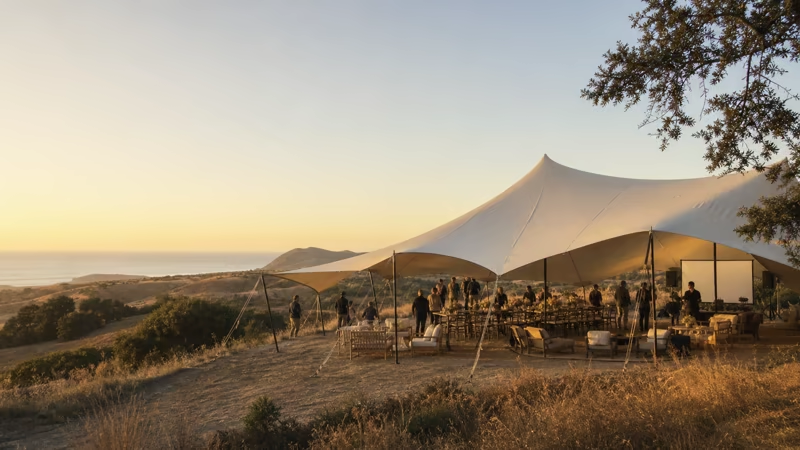
What should you send before installation?
- Event date, venue address or ZIP code, and the venue contact.
- Estimated guests and the areas that need cover: dining, ceremony, dancing, stage or lounge.
- Photos of the site, its ground surface and the delivery route.
- Available dimensions, gate access, slopes, trees, pools and other fixed obstacles.
- Venue rules, restrictions on staking, and allowed installation and removal times.
The professional installation process
1. Review the site and event plan
We compare the guest layout with the available area, access and venue restrictions. The canopy footprint is only part of the space needed: anchoring, ballast, equipment access and circulation also have to fit.
2. Confirm the anchoring approach
Ground conditions, restrictions on staking and the tent configuration determine the anchoring plan. Hard surfaces may require ballast and additional delivery access. The installation crew determines the equipment and layout for the specific site; there is no universal stake count or ballast weight for every event.
3. Coordinate arrival and site preparation
Agree on the installation window, access route and areas that must be cleared. Tell the crew about underground services and any restrictions on disturbing the ground before work starts. Keep the work area separate from guests and other event activity.
4. Install the approved configuration
The trained crew handles the fabric, poles, anchoring and tensioning for the agreed configuration. This planning overview is not a rigging manual: the installation follows the equipment documentation and site-specific plan.
5. Review the setup before the event
Before furniture and decor are finalized, coordinate circulation, access to exits, service zones and any approved lighting or attachments. Confirm who to contact if weather or site conditions change.
6. Remove the tent on the agreed schedule
Confirm when guests, furniture, florals and other suppliers will be clear of the tent. Our rental service includes removal; venue access and strike timing are part of planning the job.
Grass, concrete and uneven ground
A lawn is not automatically ready for stakes, and a patio is not automatically unsuitable. Soil conditions, underground services, anchor permissions, slopes and equipment access all matter. Send photos of both the tent area and the route from the delivery vehicle.
Weather planning is part of the layout
Waterproof fabric does not settle every weather question. Drainage, open sides, exposure and changing forecasts still affect the event plan. Agree on operating limits and a response plan with the installation team; guests and event staff should not adjust poles or anchors themselves.
How long does installation take?
The schedule depends on tent size, access, anchoring method and linked structures. Share the venue’s access window before booking so the crew can confirm an installation and removal schedule for that job. Decorating time should be planned separately from tent installation.
What is included in a Southern California rental?
Our full-service rentals cover the planned tent, delivery, professional installation and removal. The quote identifies site requirements and selected extras. Ballast, travel and options such as lighting, flooring or walls affect the final scope.